pharmaREADY 2026: Building the Future of Regulatory Operations with AI, eCTD 4.0 and Connected Technology
From regulatory publishing to intelligent, connected regulatory operations, the latest pharmaREADY User Group Meeting brought together industry perspectives, technology roadmaps and practical insights on what comes next.
On August 27, 2026, Navitas Life Sciences hosted its latest pharmaREADY User Group (PUG) meeting, bringing together regulatory professionals and technology leaders for a conversation on the future of regulatory operations.
Held virtually, the session explored a central question facing pharmaceutical companies today: How can regulatory teams become more efficient, compliant and future-ready as submission requirements evolve and AI becomes increasingly embedded in regulatory workflows?
The discussions covered the evolving regulatory submission process, the transition to eCTD 4.0, regulatory information management, AI-enabled regulatory workflows, labeling automation and the expanding capabilities of the pharmaREADY ecosystem.
Two decades of regulatory innovation and what comes next
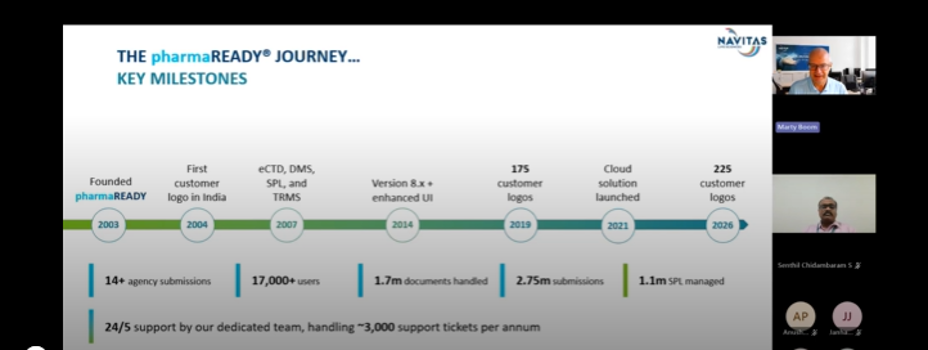
The meeting opened with a look at the pharmaREADY journey and its growth alongside the changing needs of the pharmaceutical industry.
Today, pharmaREADY supports a substantial global regulatory footprint, with 225 customer logos, 17,000+ users, 1.7 million documents handled and 2.75 million submissions, alongside more than two decades of product evolution.
This scale provides an important foundation for the next phase of regulatory submissions management. The focus is shifting from simply publishing compliant dossiers to creating connected regulatory operations that can support planning, data management, lifecycle activities, intelligence and automation.
The upcoming regulatoryREADY roadmap reflects this direction, with planned developments spanning eCTD 4.0, RIM, enterprise document management, labeling, analytics and AI-enabled capabilities. The roadmap also introduces specialized AI agents across regulatory workflows and the Enterprise RAAS platform, bringing Regulatory Services and Technology together.
In other words, the future of regulatory submission management is becoming increasingly connected.
Customer Testimonial
One of the highlights of the meeting was the customer perspective from an Associate Executive VP – Regulatory Affairs at a major Indian multinational drug manufacturer founded in 1977. He shared his experience of using pharmaREADY for over 20 years and the criteria that shaped their decision to continue with a single, integrated regulatory platform.
Regulatory Document Submission.
The needs discussed during the meeting were familiar to many global regulatory organizations, like scale across markets, end-to-end integration, first-time-right submissions and the ability to manage increasing submission volumes without proportionally increasing headcount.
The pharmaREADY experience brings together document management and eCTD publishing, multi-agency readiness, built-in validation, lifecycle tracking and regulatory expertise.
Its submission workflow spans five critical stages:
Ingest → Assemble → Validate → Track → Deliver
Documents are ingested and managed with version control and audit trails; dossiers are assembled using automated structuring logic; agency-specific validation checks are performed before submission; regulatory activities are tracked across the product lifecycle; and validated dossiers are delivered to health authorities.
The result is a more standardized and governed approach to regulatory document submission.
eCTD 4.0: Preparing for the next generation of submissions
A major focus of the PUG meeting was eCTD 4.0 and for good reason.
As agencies around the world move toward the new standard, organizations need to think beyond a technical upgrade. eCTD 4.0 introduces changes to submission structure, metadata, lifecycle management and content reuse that can have implications across people, processes and technology.
The current implementation landscape varies by region. The meeting highlighted, for example, that the US FDA has accepted eCTD 4.0 since September 2024 and has a mandatory timeline by 2029, while Japan's PMDA has had voluntary implementation since 2022 with a 2026 mandatory milestone noted in the presentation. Health Canada has voluntary implementation in 2026 and a mandatory milestone by 2028.
For organizations developing their regulatory submission roadmaps, preparation therefore needs to begin well before a mandatory deadline.
The discussion highlighted several important eCTD 4.0 changes:
- A new XML schema creates more structured submission content.
- Document reuse can reduce duplication and improve consistency.
- Controlled vocabularies support standardized metadata and terminology.
- Two-way communication can enable more dynamic agency interaction.
- Enhanced lifecycle management provides greater flexibility.
- Greater harmonization can support more consistent approaches across regions.
The technical changes also simplify aspects of the submission structure, including a move toward a single Submission Unit XML, enhanced lifecycle operations, more flexible file management and simplified sequence numbering.
The bigger opportunity
The transition to eCTD 4.0 creates opportunities for greater automation, content reuse, analytics and AI. That makes eCTD 4.0 an important building block for the future of electronic regulatory submission systems.
Customer Story 2:
From regulatory publishing to connected regulatory lifecycle management
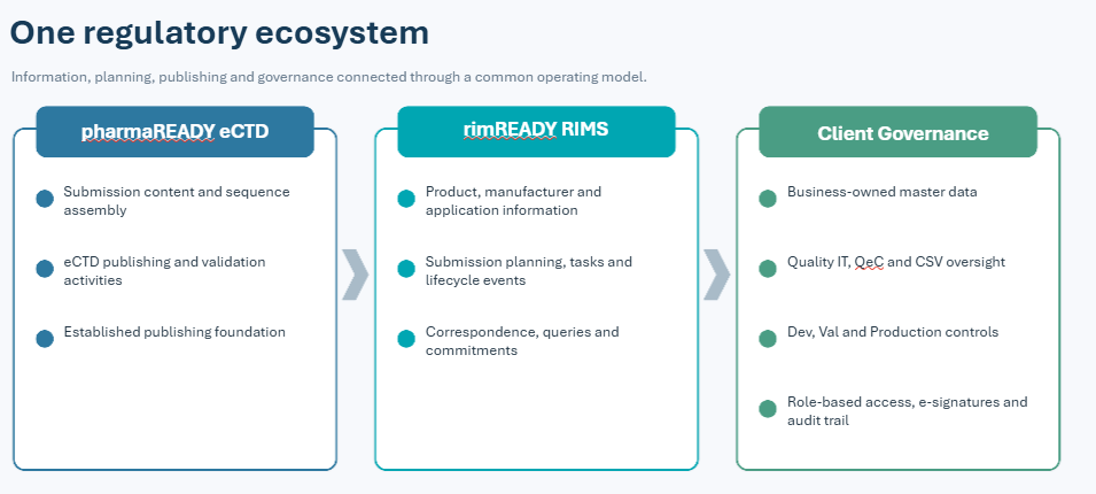
Another customer story explored eCTD publishing toward a more connected regulatory lifecycle model. The journey demonstrated how an organization can build on its existing publishing infrastructure while connecting regulatory information, application planning, lifecycle activities, correspondence and commitments through a common operating model.
The transformation involved three important dimensions:
Information. Planning. Execution.
The approach connected pharmaREADY eCTD capabilities with regulatory information management through rimREADY, while maintaining business ownership, Quality IT oversight, validated environments, controlled access and audit trails.
This represents an important evolution in regulatory submissions management. Instead of treating each submission as an isolated publishing event, regulatory teams can move toward a lifecycle model in which information is connected across products, markets, applications, submission plans, correspondence, queries and commitments.
AI moves from experimentation to practical regulatory operations
The conversation around AI has increasingly moved beyond proof-of-concept experimentation toward practical, targeted applications within regulatory operations.
Navitas highlighted AI capabilities already being deployed or piloted across areas such as:
- Submission planning and quality review
- Predictive analytics
- Document classification and metadata extraction
- Labeling and artwork development
- Regulatory data quality and stewardship
- Regulatory intelligence and impact assessment
- Health Authority query response support
- Content search and knowledge retrieval
- Labeling content comparison and translation
The future vision is equally significant.
AI-enabled regulatory intelligence could provide real-time updates on guidelines and country requirements. AI-assisted authoring could support CTD content generation, gap analysis and intelligent document versioning. Predictive compliance could help identify potential deficiencies before submission, while richer metadata could enable greater content reuse across markets.
This is where the question of How does regulatory publishing software improve the submission process? becomes increasingly relevant.
The value is no longer limited to faster document assembly. Intelligent regulatory technology can help teams identify information, automate repetitive activities, improve consistency, surface potential risks and give regulatory professionals more time to focus on strategy.
Regulatoryready: One platform. Multiple specialized regulatory agents.
The meeting also showcased the Navitas AI platform and its specialized agents across the regulatory lifecycle. The ecosystem brings AI capabilities to docuREADY, pharmaREADY eCTD, rimREADY and labelREADY, with use cases including interactive search, document comparison, AI-assisted drafting, eCTD legacy-to-RPS migration, regulatory intelligence alerts, RIM metadata extraction, query-response pattern analysis, label comparison and impacted-market analysis.
This specialized approach is particularly important for regulated environments. Rather than positioning AI as a generic tool, the focus is on applying it to specific workflows with appropriate controls and human oversight.
Rethinking labeling and artwork with AI
The final technology showcase focused on labelREADY powered by AOTM PACKX and the potential to transform pharmaceutical packaging artwork workflows.
Traditional artwork processes can involve multiple tools and manual handoffs, from artwork creation and barcode applications to proofing and validation. The AI-powered approach brings these activities together within a single workflow with human-in-the-loop verification.
The workflow covers:
Smart Briefing → Artwork Automation → Intelligent Proofing → Controlled Release
Capabilities include input validation, automated artwork generation, barcode generation and validation, Braille generation, AI-powered content and pixel proofing, technical validation, regulatory content checks, stakeholder approval and complete audit traceability.
The platform is designed to bring authoring, correction and proofing together, reducing reliance on multiple third-party tools and minimizing handoffs.
The presentation highlighted potential outcomes including 5X ROI, 80% efficiency gain and 100% accuracy for critical elements, alongside significant reductions in cost and delivery time.
What does the future of regulatory technology look like?
The discussions at PUG 2026 point toward a regulatory environment where technology is increasingly expected to do more than facilitate compliance.
Regulatory teams need solutions that can:
- Keep pace with evolving agency mandates
- Support increasingly structured submission formats
- Connect regulatory data across the product lifecycle
- Reduce repetitive manual work
- Improve first-time-right quality
- Provide stronger auditability and governance
- Enable intelligent content reuse
- Surface regulatory intelligence when it matters
- Scale across markets and submission volumes
- Help regulatory professionals spend more time on strategic decisions
This also answers a broader industry question: What services are typically offered for regulatory submission management in pharma?
The conversation continues beyond the meeting
The PUG meeting was a conversation about where regulatory operations are heading and how organizations can prepare. As regulatory requirements become more complex and global submission volumes continue to grow, pharmaceutical companies need a regulatory submission management guide that goes beyond individual filings. They need a roadmap for connecting submission operations with data, lifecycle management, intelligence and automation.
The latest pharmaREADY roadmap reflects that direction, with planned releases covering regulatory mandates, RIM master data and lifecycle capabilities, enterprise DMS, analytics, labeling and eCTD 4.0.
And as AI becomes increasingly practical, the most valuable solutions will be those that combine intelligence, integration and human expertise within a controlled regulatory framework.
The organizations that prepare now will be better positioned to manage this change with greater speed, consistency and confidence.
Whether you are evaluating regulatory publishing software, preparing for eCTD 4.0, modernizing your regulatory operations or exploring AI-enabled automation, Navitas Life Sciences can help you build a future-ready regulatory publishing system.
Reach out to explore how pharmaREADY and Navitas’ end-to-end regulatory capabilities can support your next stage of transformation.
Partner with Navitas Life Sciences to make your regulatory operations future-ready.
Missed the session? Catch the recording
The pharmaREADY User Group 2026 session is now available to watch on demand, featuring insights on eCTD 4.0, AI-powered regulatory operations, regulatory technology and the future of connected submission management.
Learn more about our services and solutions by reaching out to us at This email address is being protected from spambots. You need JavaScript enabled to view it..